
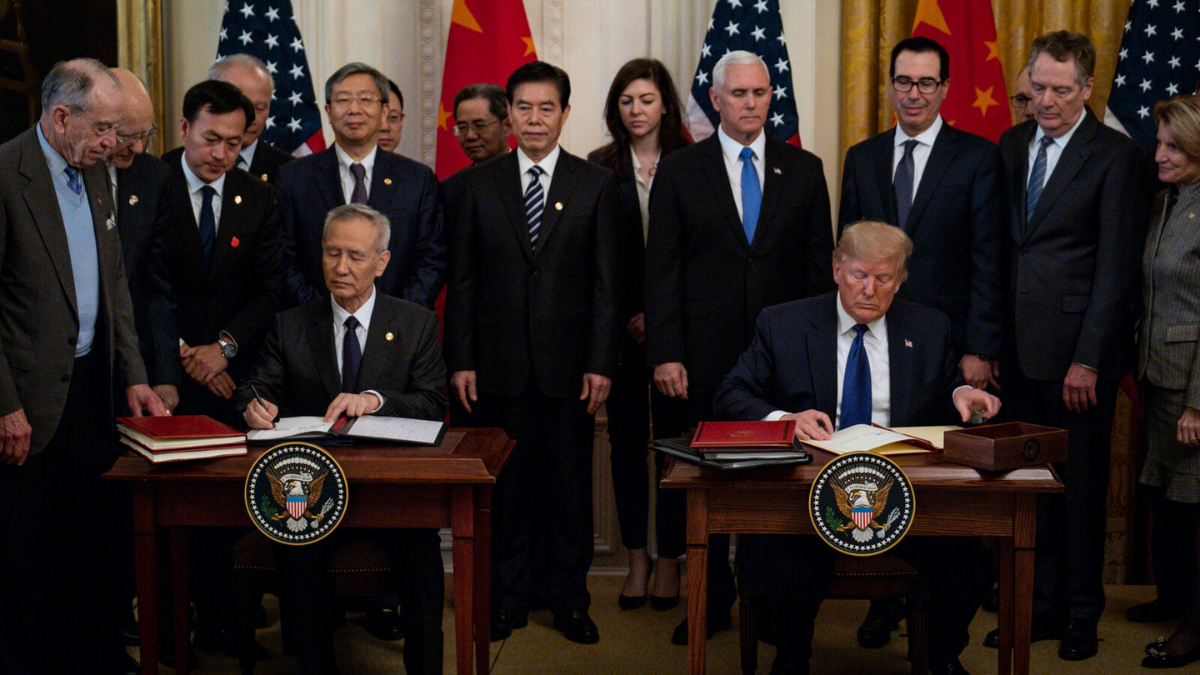
Summary – US President Donald Trump’s recent statements on Beijing signal a pivotal moment in US-China relations with far-reaching global economic and geopolitical consequences.,
Article –
US President Donald Trump recently made assertive remarks claiming that Washington holds “incredible cards” against Beijing and suggested that if he chose to use them, he could “destroy” the world’s second-largest economy. This development has reignited tensions between the two global superpowers, raising concerns about the future trajectory of their complex relationship and its broader implications for the global economy and geopolitical stability.
Background
The timeline of US-China relations has been characterized by competing interests and cooperation across various domains. Over the past decade, the relationship has evolved amid trade disputes, technological rivalry, and ideological differences. Tensions escalated notably during the trade war initiated in 2018, where both countries imposed tariffs on hundreds of billions of dollars’ worth of goods, trying to recalibrate trade balances and protect intellectual property.
Diplomatic exchanges during President Trump’s tenure often featured confrontational rhetoric and policy measures targeting China’s economic practices and expanding global influence. The recent statements build upon this ongoing series of confrontations, with explicit escalatory language that underscores the heightened friction.
Key actors in this scenario include:
- The United States government under President Donald Trump, prioritizing countering China’s perceived unfair trade practices and geopolitical ambitions.
- The Chinese government, led by President Xi Jinping, aiming to assert China’s position as a global economic and political leader.
- Multinational corporations, global trade organizations, and allied nations in regions such as Europe and Asia, navigating the ripple effects of the US-China rivalry.
The Global Impact
Economically, China’s position as the world’s second-largest economy means that any conflict or sanction measures could:
- Disrupt global supply chains
- Impact commodity markets
- Heighten market volatility
The possibility of the US exercising its “incredible cards” suggests potential use of economic sanctions, tariffs, or restrictions on technology transfers, particularly in sectors like telecommunications and semiconductors where China seeks global dominance. This standoff contributes to uncertainty around globalization trends, prompting nations and corporations to rethink dependence on bilateral trade and manufacturing hubs.
On the geopolitical front, the assertiveness of the US and China reflects a broader competition for influence across the Indo-Pacific region and beyond. The US strengthens ties with regional allies through frameworks such as the Quadrilateral Security Dialogue (Quad) with Japan, Australia, and India, while China advances its Belt and Road Initiative to expand its strategic footprint. Military posturing and diplomatic engagements continue to be a delicate balancing act as both powers seek to avoid outright conflict but vie for supremacy.
Reactions from the World Stage
International responses have been varied:
- European Union member states have expressed concern over escalating tensions affecting global trade stability but advocate for dialogue to mitigate risks.
- Several Asian nations, including those in ASEAN (Association of Southeast Asian Nations), are navigating a cautious path, balancing economic dependence on China with security partnerships involving the United States.
- Global economic institutions urge de-escalation and emphasize strengthening multilateral cooperation to address common challenges such as supply chain resilience and climate change.
Expert commentary highlights that while provocative language can serve as a strategic tool for negotiation leverage, it also risks miscalculation. Analysts underscore the importance of diplomatic backchannels and engagement mechanisms to prevent unintended escalation that could harm both economies and the international order.
What Comes Next?
The trajectory of US-China relations remains uncertain. The possibility of the US deploying its so-called cards against China depends on a complex calculus involving domestic political considerations, international pressure, and strategic objectives. Both countries may explore avenues for dialogue, particularly in areas of mutual concern such as public health and climate change, to stabilize relations.
Nevertheless, the era of unmitigated cooperation appears to be over, replaced by a competitive coexistence with strategic rivalry. Businesses and policymakers worldwide will need to brace for continued volatility in economic policies and geopolitical maneuvers. The evolution of this critical relationship will influence global governance frameworks and economic integration for years to come.
As global observers watch closely, the core question remains: how will the United States and China navigate their profound differences without tipping into deeper conflict?
About The Author

